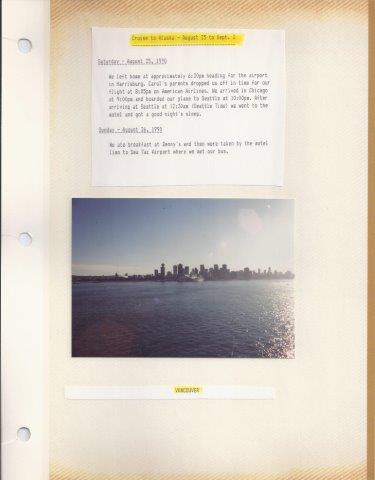
Only a few months after experiencing the intense Caribbean sun in St. Martin, Carol and I entered an almost completely different environment. Our Alaska journey began on Saturday, August 25, 1990, when Carol’s parents drove us to the airport in Harrisburg. We flew on American Airlines through Chicago and reached Seattle shortly after midnight. After a night at a nearby motel and breakfast at Denny’s, a shuttle returned us to Sea-Tac Airport, where we met the bus that would take us to the ship.
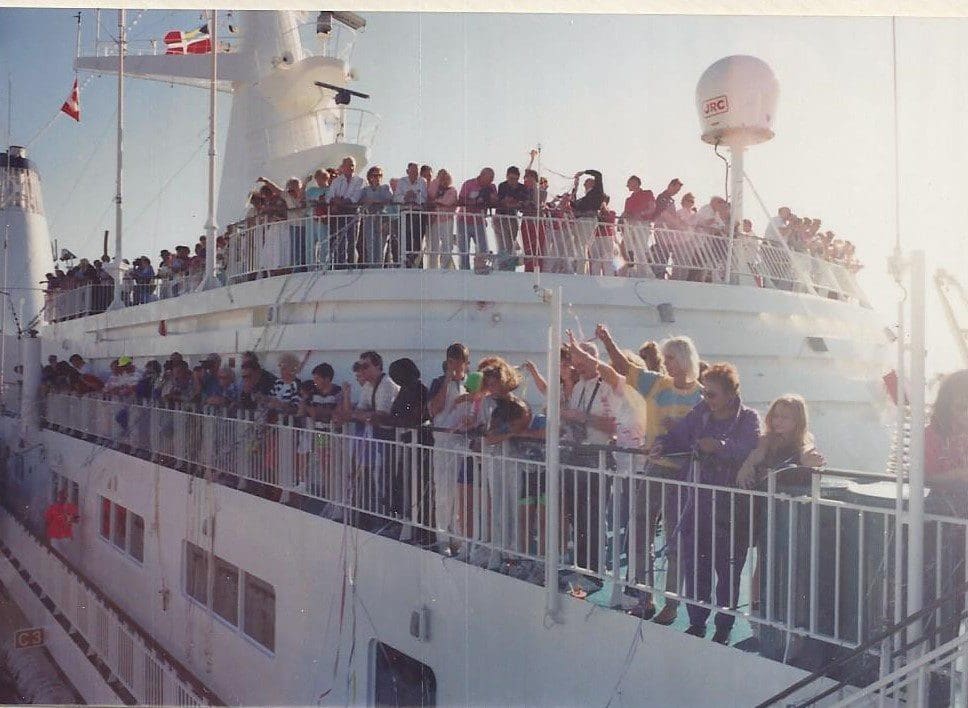
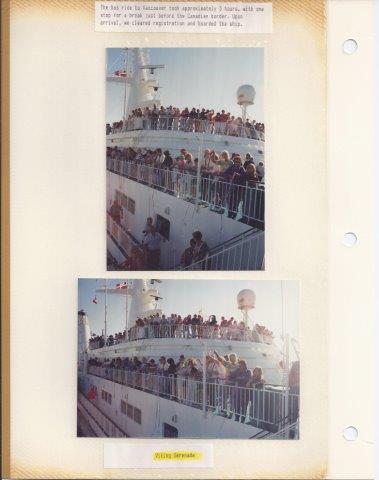
The bus ride to Vancouver took approximately three hours, including a rest stop shortly before the Canadian border. In Vancouver, we completed registration and boarded Royal Caribbean’s Viking Serenade for a cruise north along the Pacific coast to Alaska. Watching the crowded decks during departure and seeing Vancouver’s skyline recede across the water added to the excitement of beginning the voyage. Our itinerary would introduce us to Alaska’s Inside Passage, Tracy Arm, the North and South Sawyer Glaciers, and the port communities of Skagway, Juneau and Ketchikan.
The contrast with the Caribbean could hardly have been greater. St. Martin had taught me to respect tropical heat and intense sunlight. Alaska introduced cold air, coastal mountains, glaciers, forests and communities separated by water and enormous distances. Within a relatively short period, travel had carried us from one environmental extreme to another.
This ability to experience dramatically different parts of the world was one of the reasons travel became so important to me. Geography was no longer an abstract school subject. Climate, latitude, mountains, oceans and ice became physical experiences that influenced what we wore, how we traveled and what we could see.
Sailing North From Vancouver
Seattle served as our air gateway, but the cruise itself began in Vancouver. As the ship traveled north, the city skyline and developed shoreline gradually gave way to forests, islands, narrow waterways and more isolated communities.
Traveling by sea helped us understand why ships have always been important to Alaska. In many parts of the state, mountains, islands, weather and limited roads make water or air transportation essential. Coastal communities are connected not only by highways but also by ferries, fishing vessels, cruise ships and aircraft.
From the deck of the Viking Serenade, we watched the landscape change mile by mile. The route itself became part of the experience. Forested shorelines, distant peaks, mist and cold water created anticipation before we reached the ports.
Our earlier cruises through French Polynesia and Hawaii had already developed our appreciation for ship travel. Alaska demonstrated that cruising was not limited to tropical destinations. A ship could also carry us comfortably into a colder and more rugged environment.
The vessel provided meals, lodging, entertainment and transportation, but the scenery outside was the real attraction. Each morning offered the possibility of another coastline, harbor or mountain view.
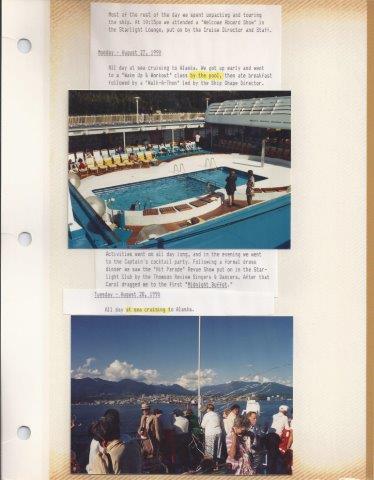
The first two days were largely spent at sea. We quickly settled into the familiar rhythm of shipboard life. One morning began with a “Wake Up and Workout” class beside the pool, followed by breakfast and a walk-a-thon led by the ship’s shape director. Other activities filled the day, and the evenings included the captain’s cocktail party, formal dinner, the “Hit Parade” revue in the Starlight Lounge and, for those still hungry, a midnight buffet. On another evening we heard a vocalist, a comedian and harmonica player Harry Bee. The entertainment was enjoyable, but by then we were too tired to visit the buffet.
These ordinary details help recover what the cruise actually felt like. Alaska was the destination, but the voyage also included exercise on deck, shows, formal meals, crowded railings and the anticipation shared by passengers whenever new scenery appeared.
Tracy Arm and the Sawyer Glaciers
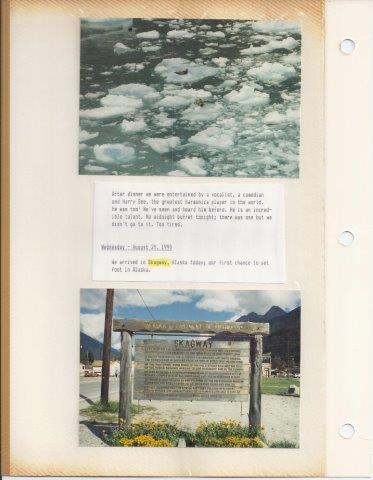
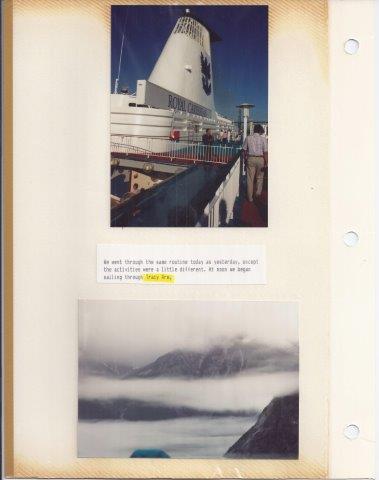
On August 28, the landscape changed dramatically as the Viking Serenade entered Tracy Arm. The narrow fjord carried us between steep mountains whose upper slopes disappeared into low clouds. Small icebergs and broken pieces of blue-white ice floated around the ship as we approached the North and South Sawyer Glaciers.
Our first stop was the North Sawyer Glacier. According to my scrapbook notes, the captain brought the ship to within about 500 feet before turning and continuing toward the South Sawyer Glacier. Whether measured precisely or simply remembered as remarkably close, the experience made the glacier feel immense and immediate.
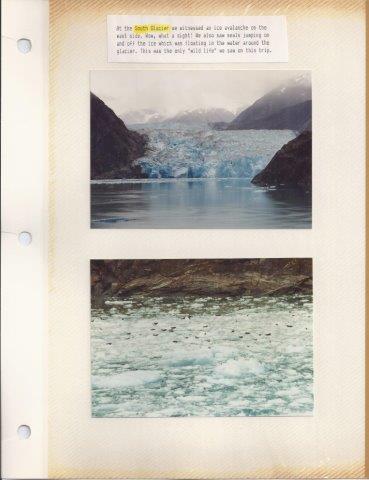
At the South Sawyer Glacier, we witnessed ice break away from the eastern side in an avalanche-like collapse. The sudden movement and force of the falling ice transformed the glacier from a distant frozen landscape into something visibly alive. We also saw seals resting on and moving among the floating ice. They were the only wildlife we recorded seeing during the cruise, which made the sighting especially memorable.
The photographs preserve the fjord as it appeared that day: dark rock walls, mist, glacier faces, calm water and a scattered field of ice. Long before our later visits to Alaska, Tracy Arm gave Carol and me our first close view of the enormous forces that shape the state.
Alaska—A State on an Enormous Scale
Visiting Alaska also advanced my personal goal of traveling to all fifty states. Hawaii had already extended that goal far into the Pacific. Alaska now carried it into the far north.
Alaska became the forty-ninth state in 1959, followed by Hawaii later that same year. Yet its identity had been shaped long before statehood by Alaska Native peoples, Russian colonization, the United States’ purchase of the territory from Russia in 1867, gold rushes, fishing, military importance and the development of natural resources.
The state’s size is difficult to comprehend from a map alone. Alaska is larger than many countries and contains mountains, glaciers, tundra, forests, rivers, islands and extensive Arctic and Pacific coastlines. Many areas remain remote and cannot be reached by ordinary roads.
Our cruise visited only a narrow portion of southeastern Alaska. At the time, however, simply being there felt like a major accomplishment. I could add Alaska to the states I had personally visited, but the experience immediately demonstrated that checking it off a list would not be the same as understanding it.
Alaska was too large and varied to be captured by one coastal itinerary. The cruise gave us an introduction, not a complete portrait.
Ketchikan—A Coastal Community Shaped by Water
On Friday, August 31, we arrived in Ketchikan, a compact community sprawling along the waterfront and climbing the steep hills of Revillagigedo Island. The name was described in our scrapbook as meaning “Thundering Wings of an Eagle” in the Tlingit language, and the town proudly called itself the Salmon Capital of the World. Its location along the water and its surrounding forests helped explain why fishing, timber, transportation and tourism became so important to the community.
Southeastern Alaska receives considerable rainfall, which supports the dense temperate rainforest. The moisture, trees, mountains and waterways created a landscape very different from the dry environments I would later know around El Paso and Santa Teresa.
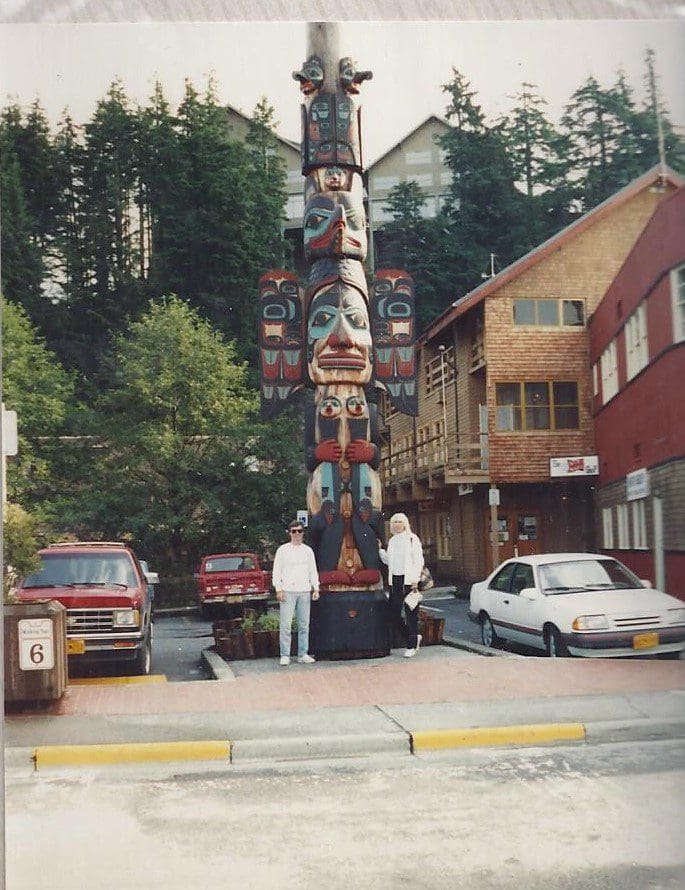
Rather than joining a formal excursion, Carol and I explored Ketchikan on foot. We began at the Chief Johnson Totem Pole, a replica of the original pole that stood on that site from 1901 until 1982. The replica had been carved by the Tongass Tribe of Tlingits. From there we continued to Creek Street, a boardwalk built on pilings above Ketchikan Creek. The picturesque buildings had once formed Ketchikan’s notorious red-light district, which remained active until 1954; by the time of our visit, the former houses of ill repute had become respectable shops and other businesses.
We also stopped at the Totem Heritage Center, where historic poles rescued from abandoned Tlingit and Haida villages were protected and displayed. Seeing the older carvings indoors, followed by poles standing in their natural southeastern Alaska setting, gave us a better appreciation for their scale, age and workmanship.
Our final destination was Saxman Totem Park, about two and one-half miles outside town. We started walking toward it, but a local resident stopped and offered us a ride. Accepting that spontaneous kindness turned an ordinary transfer into one of those small human moments that organized itineraries rarely provide. At Saxman, the collection of poles set against the forest and mist-covered mountains strengthened the connection between the carvings, the Native communities that created them and the landscape in which their stories developed.
Ketchikan introduced us to the importance of Alaska Native cultures, particularly those of the Tlingit, Haida and Tsimshian peoples. Totem poles and carved art are among the most visible expressions of those traditions, but their meaning extends far beyond decoration. They can preserve family histories, identities, stories and relationships.
A short cruise stop could provide only a limited introduction to these cultures. It was important to recognize that Alaska Native people were not figures from a completed past. They remained living communities preserving languages, traditions and political identities while adapting to the modern world.
Ketchikan’s waterfront reinforced the idea that Alaska’s coastal communities faced practical conditions unfamiliar to many visitors. Weather, tides, ships and access to supplies were part of everyday life rather than scenic additions to a vacation.
Skagway—The Road Toward the Gold Fields
Skagway carried us into the history of the Klondike Gold Rush. Beginning in the late 1890s, thousands of people arrived in the region hoping to reach gold fields in Canada’s Yukon Territory.
The town became an important starting point for difficult routes leading inland. Prospectors had to cross mountain passes while carrying the supplies required by Canadian authorities. The journey was dangerous, exhausting and far more difficult than the romantic image of suddenly discovering gold.
Skagway demonstrated how quickly a major event could transform a community. The promise of wealth brought people, businesses, transportation systems and disorder. When the rush changed or declined, the town had to find new reasons to survive.
For a traveler, the Gold Rush story provided another lesson about self-motivation and risk. People were willing to leave familiar lives and face severe conditions because they believed opportunity existed beyond the mountains. Many failed, some died and relatively few achieved the wealth they imagined.
The history reminded me that determination is not always rewarded in the way people expect. Courage and persistence matter, but they do not eliminate risk or guarantee success. That principle applied not only to prospectors but also to investments, careers and ambitious travel plans.
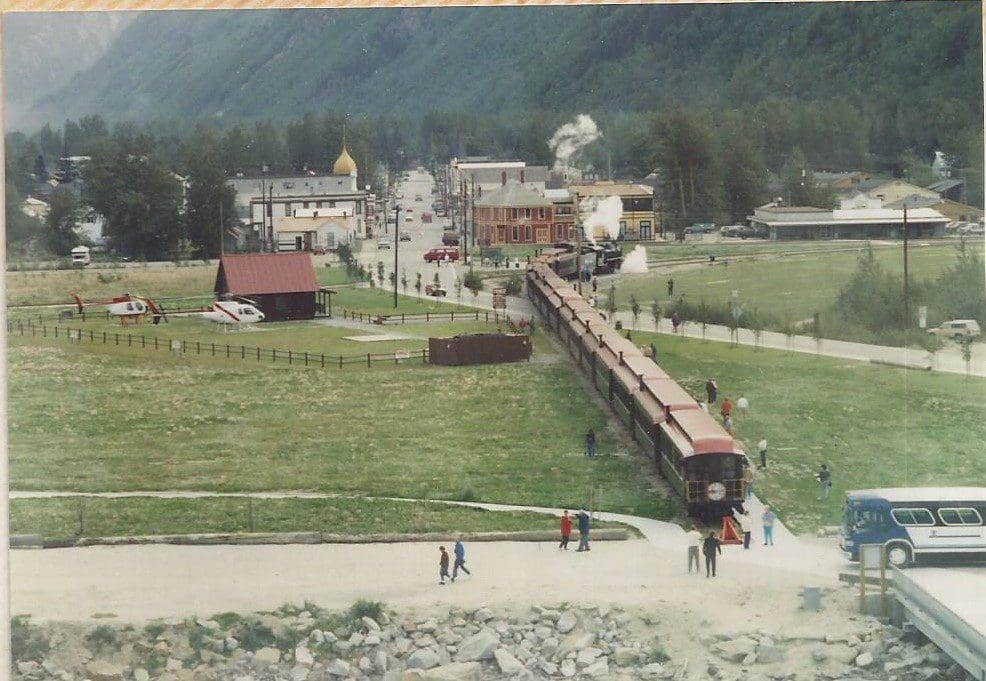
Our time in Skagway included one of the trip’s most memorable excursions: a ride on the White Pass Scenic Railroad to White Pass Summit. The narrow-gauge railroad had been built during the Klondike Gold Rush as a supply route toward the Yukon goldfields. By 1990 it operated primarily as an excursion railroad, carrying visitors over a route created for a much harder purpose.
From the train, we followed the rushing waters of the Skagway River and climbed through a narrow canyon. The track curved along steep rock walls, crossed trestles and disappeared into tunnels before emerging high above the valley. Portions of the old trail used by gold seekers could still be seen etched into the mountainside. Looking down from the passenger car made it easier to appreciate both the engineering achievement of the railroad and the physical hardship endured by the people who had crossed the pass on foot with heavy supplies and pack animals.
For someone who would later become deeply involved in model railroading, the White Pass journey gained an additional meaning. It was not merely transportation to a viewpoint. It demonstrated how a railroad could be built to answer an urgent geographic and economic need, conquering grades, cliffs, rivers and severe weather while connecting a coastal port with the interior.
Juneau—A Capital Without Ordinary Road Access
Juneau offered another unusual lesson in geography. Although it is Alaska’s capital, the city is not connected to the rest of the North American highway system by an ordinary road. Mountains, glaciers and water shape access to the community, making ships and aircraft especially important.
This was difficult to imagine from Pennsylvania, where major cities and state capitals were linked by extensive highway networks. Juneau showed how geography can determine transportation and influence daily life.
The city’s history included Alaska Native settlement, gold mining, government and maritime activity. Its modern role as the state capital existed within a landscape far larger and more powerful than the buildings along the waterfront.
For cruise passengers, Juneau was a port of call. For the people who lived there, it was a permanent community affected by weather, distance, cost and transportation limitations. Once again, the visitor’s experience represented only one part of the destination.
Mendenhall Glacier—Standing Before Moving Ice
Our excursion to Mendenhall Glacier became one of the most memorable experiences of the cruise. For people accustomed to the landscapes of Pennsylvania, the sight of a massive glacier was extraordinary.
A glacier may appear motionless, but it is a moving body of ice formed as accumulated snow is compressed over long periods. Gravity slowly carries the ice through the landscape, shaping valleys, moving rock and leaving evidence of its passage.
Standing near Mendenhall Glacier helped transform another geographical concept into direct experience. A photograph could show its color and general shape, but being there communicated its scale, temperature and relationship with the surrounding mountains and water.
The glacier also taught a lesson about time. Ice contains a record of earlier snowfall and climate conditions. It appears permanent when viewed during a short visit, yet glaciers grow, move and retreat in response to long-term environmental changes.
Looking back from the present, the visit has additional meaning because Mendenhall Glacier has continued retreating. The landscape seen by future visitors will not be exactly the one Carol and I encountered in 1990. That change reinforces the importance of preserving photographs and written accounts while also accepting responsibility for the vulnerability of the natural world.
The glacier was magnificent, but it was not merely scenery. It was part of a living and changing environmental system.
The Benefits and Limits of the Cruise
The cruise gave Carol and me an efficient way to visit several southeastern Alaska communities. We could travel through coastal waters, view scenery from the ship and participate in shore excursions without arranging separate transportation and accommodations at each stop.
This convenience strengthened our interest in cruising. Every successful voyage made another seem possible. A ship could carry us to tropical islands, American states and remote coastlines that would have been much more complicated to organize independently.
However, Alaska also made the limitations of cruise travel increasingly clear. We arrived in a port, spent a limited number of hours seeing selected attractions and then returned to the ship. The itinerary provided breadth rather than depth.
We experienced what many first-time tourists see: coastal communities, organized excursions, historic districts, gift shops, scenery and a glacier near a major port. Those experiences were worthwhile, but they represented a narrow portion of an enormous state.
We did not travel deeply into Alaska’s interior. We did not experience its immense national parks, remote roads, Arctic regions or many of the communities far from cruise-ship routes. We had seen Alaska, but we had not seen enough of it to understand its true scale.
That recognition was not disappointing. It was motivating.
A Snapshot That Created a Promise
The 1990 cruise excited the senses. We felt the cooler air, saw mountains rise from the water, watched forests extend across the shoreline and stood before glacial ice. The combination of ship travel, frontier history and natural beauty made Alaska feel unlike any other state we had visited.
At the same time, the cruise taught me to think of a first visit as a snapshot. A photograph captures one view at one moment. It may be beautiful and meaningful, but it cannot show everything beyond the frame.
Our cruise was like that photograph. Ketchikan, Skagway, Juneau and Mendenhall Glacier introduced us to southeastern Alaska, but most of the state remained outside our view.
A Promise Delayed, but Not Abandoned
I left Alaska in 1990 with the feeling that someday I needed to return. I wanted to travel beyond the port cities, enter the interior and experience Alaska from the land as well as the water. I did not know exactly when that would happen or who would share the journey, but the desire had been established.
Years later, Donna and I began turning that desire into a definite plan. In July 2013, we intended to take our camper to Alaska and spend several weeks touring the state. Traveling by camper would have given us the freedom to select our own route, stop when a landscape or attraction interested us and remain longer in places that deserved more time. It would have been the kind of open-road journey we both enjoyed.
The plans required considerable preparation. Driving from New Mexico to Alaska would involve thousands of miles, changing weather, remote roads, campground arrangements and dependable equipment. We were prepared to accept those challenges because the journey represented more than an ordinary vacation. It was our opportunity to see the parts of Alaska that my 1990 cruise had only suggested.
Then, in June 2013, my priorities changed immediately.
I was diagnosed with serious heart problems and entered the hospital for a mitral-valve repair and double-bypass surgery. The planned July camper journey was no longer possible. Alaska had to be set aside while my health, surgery and recovery became the only journey that mattered.
The cancellation was deeply disappointing, but there was no reasonable alternative. Travel requires courage, but courage does not mean ignoring a serious medical condition or continuing with a plan simply because time and money have already been invested. Sometimes the most responsible decision is to stop, accept help and give the body time to recover.
The experience placed travel into a new perspective. Until then, I could usually assume that another year and another opportunity would be available. The heart diagnosis reminded me that health can change quickly and without regard for reservations, routes or personal dreams. “Someday” is never guaranteed.
At the same time, I did not allow the failed 2013 plan to become the end of my Alaska story. The camper trip was cancelled, but the desire to return remained. Recovery required patience, work and a willingness to adjust my expectations. I could not control what had happened to my heart, but I could decide that, if my health permitted, travel would continue to be an important part of my life.
That determination did not mean pretending that nothing had changed. Major heart surgery affected how Donna and I had to think about distance, fatigue, medical preparation and the physical demands of a journey. Continued travel would require more careful planning and, in some cases, a different method of reaching the destination.
The change from a long independent camper journey to an organized tour was not a surrender of the dream. It was an adaptation that allowed the dream to survive.
Returning With Donna
In July 2019, approximately six years after the cancelled camper trip and nearly three decades after my first Alaska cruise, Donna and I finally returned. We selected an approximately two-week Gate 1 journey that provided the transportation, accommodations, guides and organized itinerary needed to explore Alaska more deeply.
The Gate 1 tour offered a different experience from the camper journey we had originally planned. We gave up some of the independence of setting our own route, but we gained an efficient and manageable way to reach important destinations without the physical strain of driving thousands of miles and maintaining a camper through remote country.
We visited Denali and Wrangell–St. Elias national parks, rode the Alaska Wilderness Express, rafted the Nenana River, traveled through Prince William Sound and flew in a small aircraft between Kennicott and Chitina. We also put on crampons and walked on Root Glacier.
These experiences gave me the land-based understanding of Alaska that had been missing from the 1990 cruise. We traveled into the interior, entered immense protected landscapes and experienced Alaska through trains, boats, aircraft, roads and our own physical effort.
Walking on Root Glacier was especially meaningful. In 1990, I stood near Mendenhall Glacier and admired the ice from a visitor’s perspective. In 2019, after heart surgery and recovery, I was able to strap crampons to my feet and walk on a glacier with Donna. That moment represented much more than another excursion. It was evidence that the cancelled 2013 journey had been postponed rather than permanently lost.
The return also showed that commitment to travel does not require insisting upon the original plan. If we had believed that Alaska could be experienced only through the camper journey we imagined in 2013, we might never have returned. By accepting a different approach, we preserved the purpose of the trip even though its form changed.
What Alaska Taught Me About Continuing
The full Alaska story now extends across three stages of my life.
In 1990, Carol and I experienced southeastern Alaska from the Viking Serenade. That cruise introduced Ketchikan, Skagway, Juneau and Mendenhall Glacier and created the desire to see more.
In 2013, Donna and I prepared to fulfill that desire through a long camper journey. My open-heart surgery cancelled the trip and reminded us how quickly health can change our plans.
In 2019, Donna and I finally returned through an organized Gate 1 tour. The itinerary was different from the independent camper adventure we had originally imagined, but it allowed us to see the interior, visit national parks and participate in experiences that the cruise could never have provided.
Together, these chapters taught me that determination is not the refusal to change. True determination is the willingness to protect an important goal while adapting the route used to reach it.
The first cruise planted the dream. The cancelled camper trip tested it. The later journey fulfilled it.
My heart surgery could have become a reason to stop traveling altogether. Instead, it became a reason to travel more thoughtfully. I learned to respect physical limits, prepare more carefully and recognize that organized travel could help Donna and me continue reaching demanding destinations.
The return to Alaska was therefore more than the completion of an unfinished itinerary. It represented recovery, persistence and gratitude. I was grateful to be alive, grateful to be traveling with Donna and grateful that a dream interrupted by serious illness could still be realized years later.
Alaska taught me that travel plans can fail without the dream itself failing. Routes change, health changes and the way we travel must sometimes change with them. What matters is preserving curiosity and finding a responsible way to continue.
The camper never carried us to Alaska in 2013. Nevertheless, six years later, Donna and I stood within the landscapes I had wanted to see for nearly thirty years. That experience confirmed one of the strongest lessons of my travel life: a meaningful journey may be delayed, altered or approached by a different road, but determination can keep it alive until opportunity returns.
Alaska and the Fifty-State Goal
Reaching Alaska also brought me closer to completing my goal of visiting every state. The goal gave structure to our American travels, but the list itself was never the most important result.
Every state offered something different. Alaska’s contribution was scale, wilderness, isolation and the recognition that much of the United States could not be understood through cities and highways alone.
The state also strengthened my appreciation for America’s national lands. Alaska contains protected areas so large that they preserve entire ecosystems and migration routes. Their scale demonstrates why some landscapes must be protected as connected wholes rather than as small, isolated attractions.
Visiting all fifty states meant more than being able to say I had been there. It meant seeing how varied the country truly was—from Hawaiian volcanoes and Caribbean-like beaches to Alaskan glaciers and Arctic environments.
Alaska made the United States feel larger than I had previously imagined.
The Voyage Home
After returning from Ketchikan, the evening brought another performance by Harry Bee and two other variety acts, followed by the ship’s gala midnight buffet. The chef and dining staff transformed the food into an elaborate display of almost every delicacy imaginable. Like the formal dinners, revues and other shipboard activities, the buffet was part of what made cruising feel like an event rather than merely transportation between ports.
Saturday, September 1, was our final full day aboard the Viking Serenade. We began with “Wake Up and Workout” beside the pool, then spent a quiet afternoon enjoying the ship. That evening, the cruise and entertainment staff presented a farewell show. The slower pace gave us time to absorb what we had seen before returning to ordinary life.
On Sunday, September 2, we disembarked and boarded a bus for Seattle, reaching Sea-Tac Airport around noon. There the trip ended with an unpleasant surprise: someone had broken into our luggage, and several personal belongings were missing, including souvenirs we had purchased in Alaska. We reported the loss, changed our flight plans and arrived home late Sunday night.
The theft was frustrating and cast a shadow over the journey’s final hours, but it did not define the trip. What remained most important was the experience Carol and I had shared—the glaciers, port towns, railroad, Native carvings, shipboard life and immense coastal landscape. In spite of the trouble at the airport, the cruise had been both relaxing and enjoyable.
Looking Back
I may not remember every meal, shipboard activity or detail of the Viking Serenade, but I remember what the journey awakened in me. Alaska was cold, rugged, beautiful and far too large to understand from one cruise.
The trip extended our growing passion for cruising while teaching me to recognize the difference between an introduction and a complete experience. It allowed us to see what many first-time visitors see—and gave me enough knowledge to realize how much remained beyond the cruise route.
Mendenhall Glacier made ice and geological time tangible. Ketchikan introduced the coastal rainforest and Alaska Native heritage. Skagway connected the landscape with the determination and hardships of the Gold Rush. Juneau demonstrated how geography could shape access even to a state capital.
Most importantly, the cruise planted a promise in my mind: someday I would return and see Alaska more deeply.
Nearly three decades later, Donna and I kept that promise. The first trip gave me the snapshot; the second expanded the picture. Together, they taught me that a brief journey can be valuable not because it completes our understanding, but because it gives us a reason to return.
We are planning another trip to Alaska, a cruise tour, next year, this time with Donna’s brother Steve and his wife, Cheryl, and Donna’s sister Jan. The journey will bring my Alaska story full circle by allowing me to revisit some of the destinations from the original 1990 cruise while sharing them with different family members. Alaska continues to call me back, and each return offers not only another view of the landscape but also new companions, perspectives and memories.